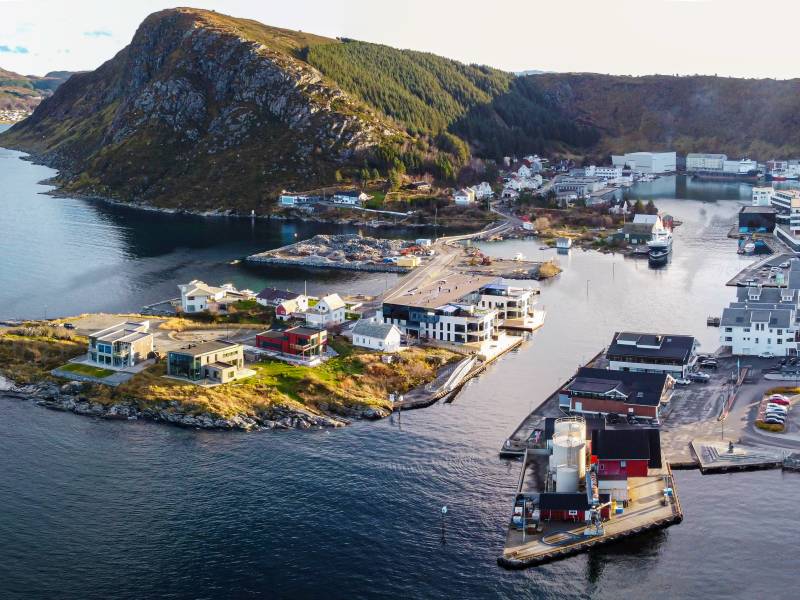
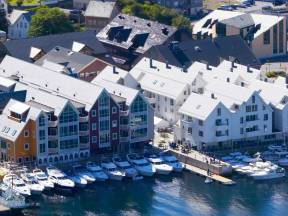
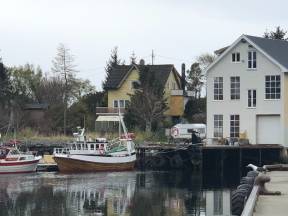
Fosnavåg means sheltered harbour, and it is a cosy town nestled in a bay. The mountains around the bay provide shelter, while the fishing ground is just a short distance away. True to its name, Fosnavåg always has a place to anchor.
As a visitor, you can use Fosnavåg guest quays with floating bridges in the outer part of the harbour in the town centre. Here you can refuel your boat, and you will also find a grocery store selling essentials, a fish counter, a selection of shops, hairdressers, a post office, restaurants, ATMs and a wine store. Thon Hotel Fosnavåg and Fosnavåg Concert Hall are worth a look too, as you are within walking distance of concerts, cinemas and a great hotel breakfast. An additional benefit of staying in Fosnavåg is the close contact with the fishing fleet that passes by on its way in and out of the harbour.
Fosnavåg is a great place to stop and wait for good weather over the Stadhavet – or for a breather after you have braved the infamous sea. Fosnavåg harbour is also perfect for those who want to use their own boat for the seafood restaurant Skotholmen, which is located on an islet out in Holmefjord.
The quays have space for around thirty boats. The water depth is three metres, and there are floating bridges with power and water supply, as well as sanitary facilities. The guest quays are operated by Herøy Kystlag while payment and registration are done at the reception at Thon Hotel Fosnavåg or via the Marina GO app.
When world-famous concert pianist Leif Ove Andsnes played at Fosnavåg concert hall, he must have been impressed, for he went home and arranged to have the same sound system from the concert hall for his own music festival.
Fosnavåg concert hall was completed in 2014 and comprises a hall that can seat 490 people and a 91-seater cinema. The opening concert featured some big names such as the Norwegian Radio Orchestra, Leif Ove Andsnes and Magne Furuholmen. Since then, a good mix of international quality, national stars and local heroes have graced the stages here to entertain the Havlandet residents.
Those who appreciate engines and coastal history will enjoy exploring the former three-storey Brødrene Nerem Mek workshop in Fosnavåg harbour. Here you'll find boats, engines, photography - and coffee. Drinking coffee and exchanging stories, both real and fictional, is an important part of our efforts to preserve coastal culture.
Here you'll find desks and signs, lighting units, medicine chests and nuts and bolts. And you'll meet people with a heartfelt passion for coastal history.
If you’re lucky, you'll also get to see herring drying from the ceiling. Coastal life is preserved with the tradition of salt and dried herring. Sometimes the herring is sold in Fosnavåg's town centre, and is always popular. 'Bokna herring' is a popular traditional food here.
THE FISKARKONA STATUE IN FOSNAVÅG TOWN CENTRE
The statue of the Fiskarkona is located on the furthest point towards the sea in Forsnavåg town centre. The statue is a well-known photographic point and meeting place for local residents.
The sea gives and the sea takes. Living conditions for people along the coast were tough.
The men fought with the forces of nature out at sea, while the women had their battles at home. They ran the family, garden and the local community, while worrying about their men at sea.
In the 1990s, Fiskarkvinnelaget in Herøy wanted to honour the fishwives and a statue was raised at the quayside in Fosnavåg. It commemorates all the fishwives and coastal woman who stood by the sea waiting for their loved ones with a baby in her arms and a second child tugging at their skirt.
The people of Herøy have also experienced tragedies at sea more recently and that's when this statue became place to light candles and come together in the footsteps of those who had experienced similar tragedies
HAVLANDET`S FISHING HISTORY
Open boats, oars and sails. That's how you fished the waters for hundreds of years. Then, towards the end of the 19th century, more and more deck boats arrived, and the beginning of the 20th century saw the arrival of the motor boat. And that changed everything. Fishermen could venture further out to sea, and the new boats were better equiped to withstand the bad weather.
The first Sunnmøre boat to take part in herring fishing off Shetland was from Herøy. The Faroe Islands and Iceland were next in line. There’s always fish to be found. During the abundant herring years of the 1950's, the fishing was literally on people's doorsteps. But when the herring disappeared, the fishermen had to go further out again, and it wasn't long before they found themselves off the coast of Canada fishing for shark.
Competition was fierce and triggered both a willingness to take risks and to adapt quickly. The boats were self-equipped, and life became about beating your neighbour to it.
More recently, the Herøy people have begun fishing north of Svalbard, west of Ireland and in the Southern Ocean - in addition to all the large sea areas off the Norwegian coast. Fishing is done in coastal boats, line boats, trawlers and 'ringnotsnurparar'. It is Herøy, along with the much larger cities of Ålesund and Tromsø, that has the most fishermen in Norway. And Herøy fishermen land seven percent of the total catch values in Norway, which amounts to almost NOK 1.5 million per year.
Value creation in fisheries has a ripple effect on land, because the fish needs to be delivered and processed. The boats need rebuilding and repairing, and they need equipment on board, from high-tech kit to food and bedding. A workplace on board a 'ringnotsnurpar' provides two workplaces on land.
The sea is the livelihood of the people who live in Havlandet.
The park in Fosnavåg has a history that in many ways reflects the development of this coastal town and its community.
Originally, this area was wild nature, swampy marshes, and a place to live. In the 1970s, it was brought under control and given plants and nicely laid gravel paths. The flat area was perfect as a circus space, and even had elephants wandering freely at one time.
There was an even bigger event in the mid-70s. There is talk of as many as several tens of thousands of visitors who wanted to see the Kvalsund ship and the then-celebrities of the time such as Dizzie Tunes, Kirsti Sparboe and Per Asplin also visited Fosnavåg. The park was a natural meeting place with large circus tents and a stage.
Over the years, the park slipped into hibernation, and was somewhat forgotten, to be later rediscovered by the residents of Fosnavåg and the municipality. It now boasts a large climbing and play facility together with a barbecue hut. The park has also been equipped with a parking lot for mobile homes and public toilets. The latest development is a new path.
Today the park is a popular meeting place for Fosnavåg residents and visitors. You'll find children playing here, alongside young people having a barbecue and visitors camping in the mobile homes or their own caravans.